
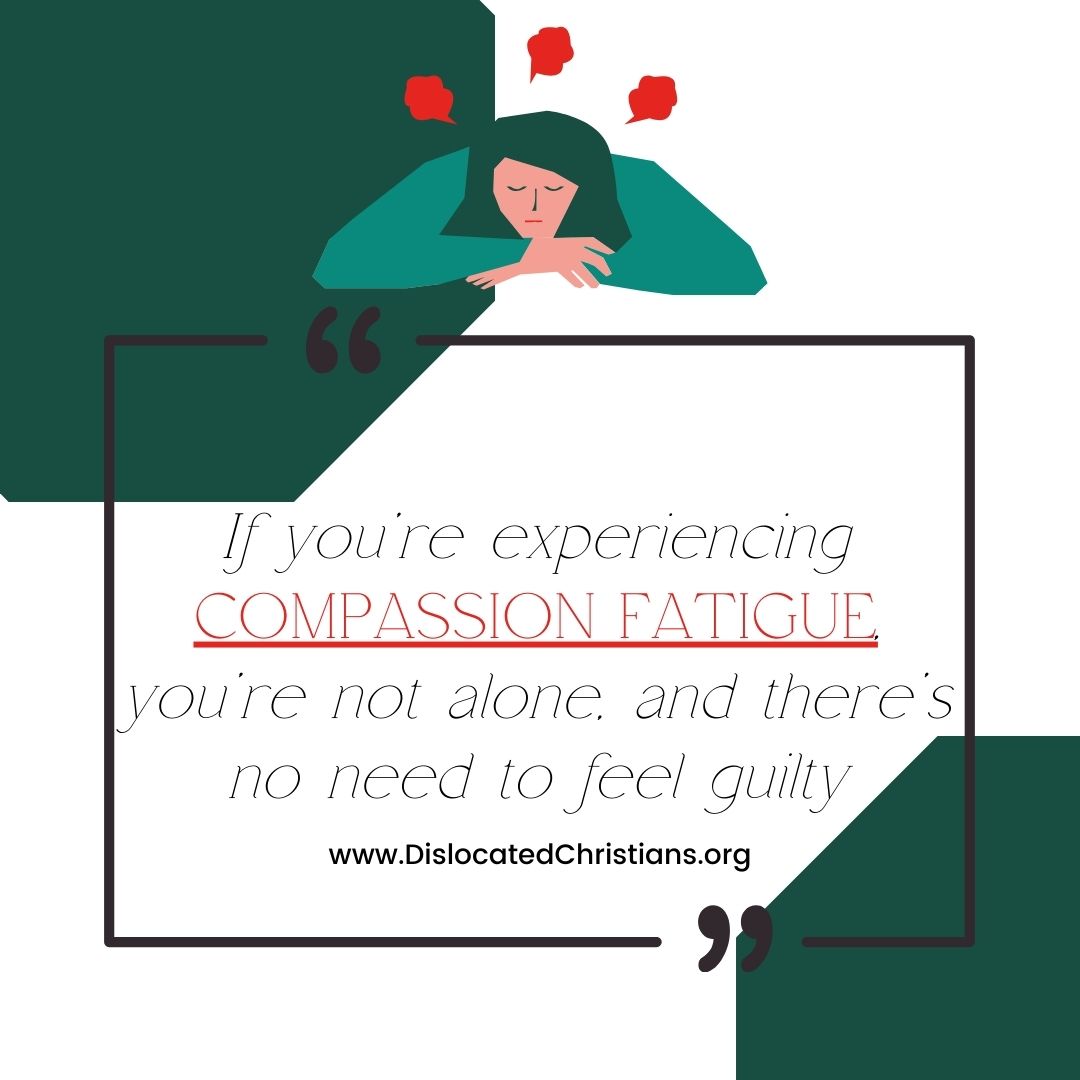
Given that we are constantly bombarded with bad news, anyone can experience Compassion Fatigue; it can be a symptom of a necessary emotional survival strategy. However, I believe that as Christians, we experience an extra layer of guilt when we go through compassion fatigue. Countless verses in the bible instruct us to care for the oppressed, and Romans 12:15, for instance, tells us to ‘mourn with those who mourn’. When we switch off, we might sense we’re disobeying God. Are we applying the Bible correctly, though? Rather than condemning us, I believe the bible might have some advice to give us as we battle feeling overwhelmed and fight our desire to withdraw.
I encountered the effects of compassion fatigue recently in a small group at my church.
A friend was in tears over the Israel-Gaza war; she had been watching the news around the clock, and it was clear she needed to switch off. Nevertheless, she thought this wasn’t a ‘Christian’ response and believed she should be engaged and informed. My daughter has the opposite reaction; she won’t watch the news because it is too upsetting and chooses to switch it off. I know her heart is soft, though, and she has a well-developed sense of right and wrong. Her passion for justice means watching the news invokes strong feelings she doesn’t know what to do with. However, our culture tells her she is weak for not coping with rolling news, and she, too, feels guilty.
It’s OK to be upset
In my view, both of these Christians are right in their responses. It’s OK to be upset when we hear that people are being maimed and killed. If we have 24-hour news droning on in our lives and feel nothing, that is wrong. It’s important to remember that 24-hour news feeds are new; in the past, we didn’t have access to the entire world’s bad news, and it is only recently that we have had photos and video footage as well. Watching a war take place on a live feed is not normal. Our media age is driven by engagement, so news channels compete to offer us ‘click-bait’ that shocks and entices us to stay tuned to them.
Even if we stay glued to our screens watching the news from Israel and Gaza unfold, we will almost certainly be missing other events in Ukraine, Sudan, Yemen, Nigeria, and countless other places. It is simply impossible to keep up to speed with everything that goes on in the world. Thank God for being far bigger and more competent than us. Only He can cope with the extent of suffering in the world.
So, what can we do?
In the Bible, we are told, ‘ Your eye is the lamp of your body. When your eyes are healthy, your whole body also is full of light. But when they are unhealthy, your body also is full of darkness.’ (Luke 11:34). This means that God cares about what we look at and take in with our eyes; we must focus on what is spiritually good for us. This can mean being careful about the images we look at; we might choose to get our news from radio and podcasts instead (The BBC Global News podcast is updated twice daily and is very informative). I’m not advocating for everyone to stop watching the news, but perhaps we could consider limiting the disturbing footage we consume. The BBC also produces a weekly Happy News pod:
Another option is to switch our focus from global to local news; why not try it for a week? By doing this, we’ll still be engaged but hopefully not overwhelmed. Again, the BBC is helpful with this and offers local TV news bulletins, radio stations and news websites. If we consume local content only, we’ll hopefully gain a better perspective. Yes, the news may still be miserable, but we’ll hear individual stories rather than statistics. For instance, a national news story about the number of people suffering from pneumonia is told on a local news website through the eyes of a particular family. It is far easier to relate to and pray for them, and the sense of overwhelming powerlessness is reduced. Similarly, a local initiative to tackle global warming might be presented as doable and impactful.
Focusing on local issues is backed up by a Bible verse in a letter between two early church leaders. Paul tells Timothy, ‘Anyone who does not provide for their relatives, and especially for their own household, has denied the faith and is worse than an unbeliever.’ (1 Timothy 5:7-9). This is an excellent reminder that we are responsible for those living near us. Unfortunately, I have encountered cases where this verse has been misapplied, and believers have used it as an excuse to ‘look after their own’ and ignore needs from further afield. It might not feel straightforward, but we can ask God to help us achieve the correct balance between supporting our family, community and the world. He’s happy to be in dialogue with us, so keep asking Him how to do this.
Enhance your mood
The most obvious way to stop feeling powerless is to do something. Studies have shown that mood-enhancing endorphins are released when we donate to a good cause. We might want to get involved with a local charity and participate in initiatives at our church (see my book Destination Transformation to discover where God might be calling you to serve). How about combining feeling healthier with making a difference by getting sponsored to undertake a challenge? We have been created for good works and can find enormous fulfilment when we help others (Ephesians 2:10).
There is power in prayer
Finally, it’s good to talk and pray together. Can we find others from our church to meet and pray with? There is power in prayer, and we find relief when we share our burdens. Ultimately, God helps us in our troubles, and Psalm 34 reminds us that he is attentive. He will deal with the wicked; we can even leave it to him to decide who they are (Isaiah 11). We don’t have to have strong opinions about who is right and wrong in any particular conflict; He will judge, and we don’t have to. Any confusion can be left to him to resolve.
Exponential kindness
So much goes on beyond the limits of our physical world. We’re told in Deuteronomy 7 that God’s love continues for generations. There is something exponentially mystical about how God blesses us and blesses those we bless. Every small act of kindness is somehow multiplied, and we can be confident that, ultimately, His Kingdom will be established. Though bad news may overwhelm us today and leave us numb, the future is in God’s hands, and for those of us with faith, it is full of hope and love.
A recent piece in ‘The Conversation’ about Compassion Fatigue presents several ways to combat it and inspired this post.
It seems I can’t stop writing about oxymorons; last week, it was ‘Evangelical Tenderness’, and before that, I wrote an entire book about ‘The Oxymoronic God’. Now, I find myself grappling with ‘Compassion Fatigue’, the idea that with so much bad news channelled at us, the only way to cope is to disengage.
DislocatedChristians exists to create and support a community of like-minded people. I’ve described myself as Dislocated because I sometimes struggle to understand how God wants me to be in the world, but not of the world. I also move house a lot!
Please like, comment on, or share my articles if you’ve found them helpful. I’d be immensely grateful if you could follow me; enter your email address towards the bottom of the page. I promise not to bombard you with messages, and you can unsubscribe at any time.
If you’d like to support my writing, please consider buying one of my books. I’m undertaking some challenging (and costly) new projects, and if you’d like to encourage me with them, please consider buying me a coffee on Kofi.
Just as we are each a work in progress, so too is DislocatedChristians. Sometimes I’ll get things wrong, and I hope you’ll forgive me and continue to stick around when that happens.
Discover more from Dislocated Christians
Subscribe to get the latest posts sent to your email.
 Dislocated Christians
1 Comment