
This might be one of the hardest articles I have written; I have been stewing over it for a couple of weeks now and have eventually concluded that I at least have to try to get some ideas down. I am desperately hopeful that this piece will help anyone who is part of a military family or cares about one.
I have been a military wife for an incredible 25 years. During that time, I’ve lived in 19 houses in four countries on three continents, which has been amazing. Yet, there is definitely an emotional toll to living like this, and until this moment, I have never felt brave enough to write about the cost and pain of moving house 19 times. I’ve lost touch with more friends than I care to remember, been misunderstood over and over and at times struggled with consuming worry and loneliness. I think it’s hard to write about these things because I still live like this. I am due to move house for the 20th time in the summer of 2025.
Many people might envy my lifestyle, which can be utterly fabulous, but there are substantial personal costs, too. I hope that by writing about those hurts here, they can be better understood by anyone who loves or prays for someone in the Army, Navy or Air Force. If you’re a military wife yourself and feel abandoned and forgotten by God and former friends, perhaps by reading this, you’ll find comfort in knowing you’re not alone. That is my goal.
So why am I writing this now? Just after Christmas, I came across artwork by the Christian artist Maya Ilunga. She is the daughter of a Swiss friend whom we met in Nepal. Having grown up all over the world herself, she now paints pieces exploring the mixed emotions those experiences have generated. Her bravery in sharing her feelings has inspired me to do the same.
When I first viewed her artwork, I was both devastated and delighted. Devastated, because her paintings triggered a flood of painful emotions as I looked at them, but I was delighted, too, because I was clearly looking at work done by someone who understood me. That was unusual, and on a spiritual level, I sensed God saying he saw me and knew me. Maya’s work has a beautiful prophetic quality, and I hope any military family member reading this experiences a similar flash of recognition. God knows every detail of your situation.
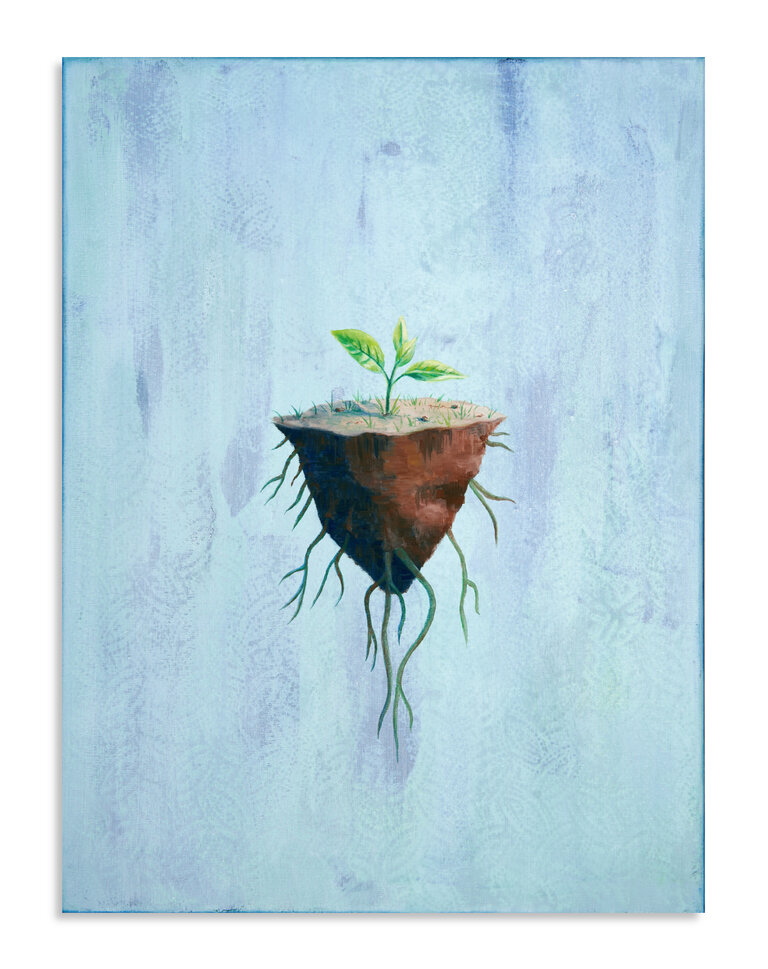
I’ll begin with the piece that broke me. The profound isolation and vulnerability of this pulled-up plant reflect my feelings of uprootedness when I move somewhere new and know no one. This is particularly the case when I move country, as nothing remains the same; the shops are different, houses and cars are replaced, and friends and family cannot visit except for significant planning. The next phase of life truly is a blank canvas, and no meaningful relationships go with me. There is excitement and a desire to grow and make the best of wherever I find myself, but how deep should I push those roots? After all, I’ll be moving again in another couple of years, and then I’ll feel like this again. Sometimes, I even wonder if sticking with the military lifestyle amounts to self-harm.
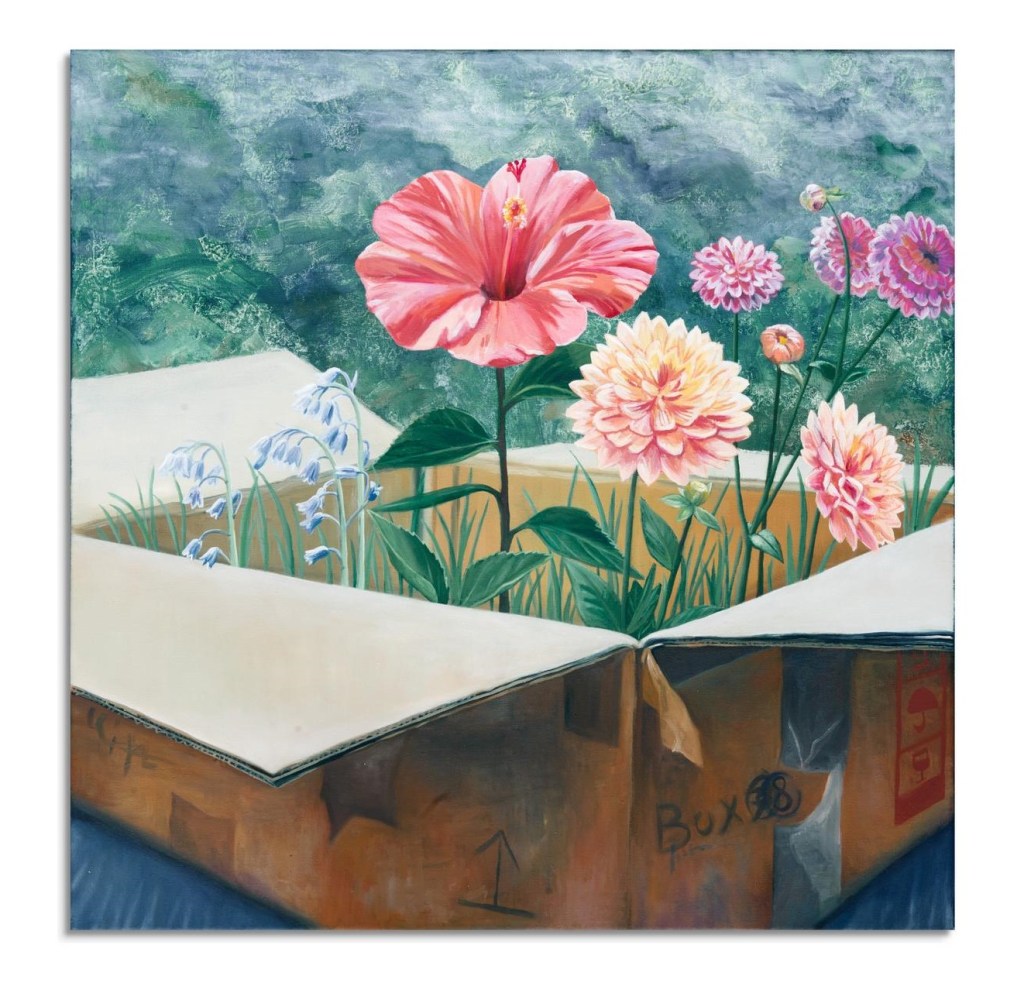
I love the bright colours on this canvas, and it portrays a far more optimistic view of moving house than the piece above. Yes, there is undoubtedly excitement when I arrive somewhere new, and I look forward to opening boxes and finding a home for my belongings. I want my home to look beautiful and reflect who I am.
However, those desires are not always realised. On occasion, the previous location has exhausted me, and rather than arriving like a bright and fresh flower, I feel more like a loosely held-together collection of petals with no energy or roots to start over. As a practised Army wife, I can easily cover that up, though, and no one would guess that’s how I feel. Just as the cardboard box in the picture obscures the flowers’ roots, I can mask my deeper layers, too. My advice for those who regularly welcome new military families to their churches is not to assume that the bright and breezy flowerheads you’ll encounter are the whole story. Take the time to really get to know your new arrivals and find out what condition they are arriving in.
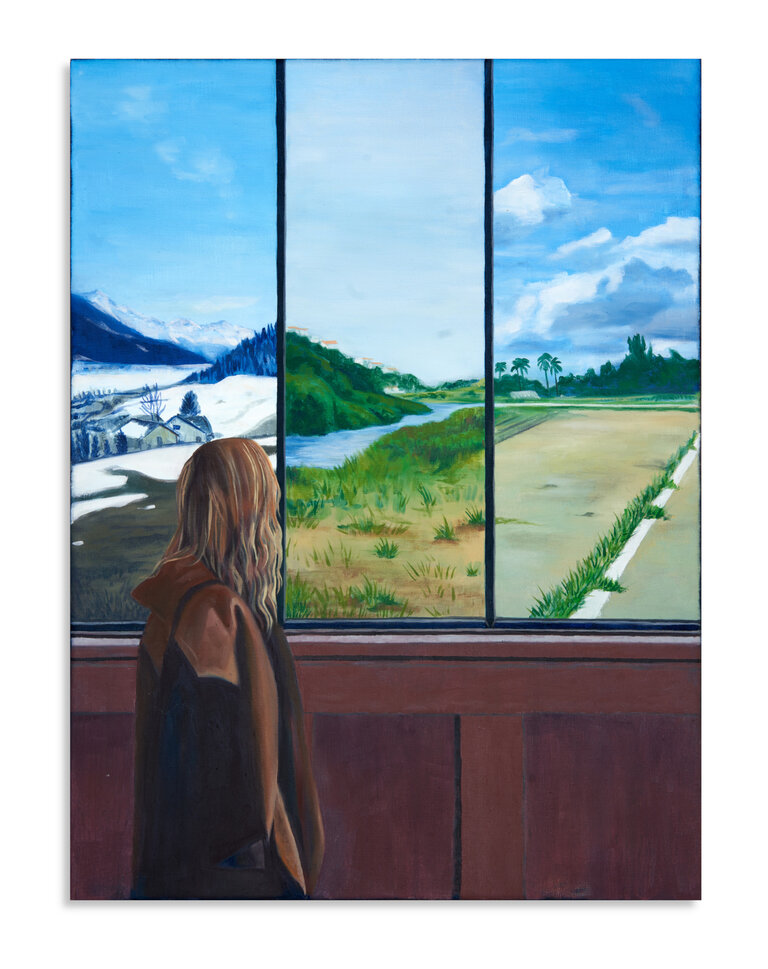
This is the last of Maya’s pieces that I want to highlight. It is such an intelligent painting and reveals a deep truth about how living with connections to many places feels. I’m often reminded of other places and people and sometimes think I live in parallel universes. A beautiful lake might prompt bittersweet memories of Alabama, Pokhara in Nepal and the Chesapeake Bay. Even church rituals can make me emotional. For instance, a warm welcome at a church door immediately takes me back to the friendly smiles that always greeted us at church in Virginia. Celebrating communion will remind me how inclusive and joyous taking bread and wine can be at English churches. On some days, my memories seem distant, but on others, thoughts of old friends can be at the forefront of my mind. I feel neither happy nor sad about these feelings, but they can be very present.
My sense of living in different worlds is reflected in the name I have given this website: Dislocated. Perhaps you can identify with this paradigm even if you’ve never moved house. As Christians, we live in both the physical world and the Kingdom of God. Sometimes, it’s hard to reconcile the two.
I hope what I’ve shared so far has encouraged you to think compassionately about military families. I’d like to offer some simple dos and don’ts for anyone involved in meeting and greeting them at church. After those, there are some ideas for military families to help them cope with the ups and downs of postings.
Ideas for Christians who would like to understand the needs of military families in their churches
Don’t delay when you meet us for the first time. Invite us to join in.
Do make sure your church groups are continually advertised. I don’t feel at home until I have joined a life/home/cell/small/community group. We’ve discovered every church has a preferred name!
Don’t assume we are experts at moving house. We aren’t given any training, and although the Army helps, we have to do it their way. Moving to a different country is infinitely harder; we often have no bank account, car, or food in the house when we arrive!
Do anything you can do to help in those first few days and weeks; act quickly when you meet a military family for the first time. It will be greatly appreciated; a meal, a lift or babysitting are all excellent. Share your local knowledge, too.
Don’t assume that we will be pleased to be home if we move back to the UK. At best, we will have mixed emotions, and if we have been away a long time, the UK may no longer feel much like home. The friends we’ve just said goodbye to might be the best we’ve ever had.
Do ask what we’ve missed about the UK and start a more extended conversation. You might be surprised by our answers and gain a new perspective on the UK and what’s great about it.
Don’t complain that military families come along for a few years and then leave your church. We’ve heard this many times, but military families have it just as hard. Usually, you will get to stay in the same area with some friends who will remain. We will have to start building relationships all over again, and again, and again.
Do acknowledge your sadness when people move on. Using it as common ground with military families is the best way; it’s an emotion you can share and bond over.
Don’t give up welcoming military families because they always move on. Ask God to give you the energy to make friends many times.
Do consider buying one of Maya’s original paintings or prints (there are postcards, too, if your budget is limited) for your church. Put it somewhere prominent; they are fantastic conversation starters and can be used to demonstrate how seriously you take the task of welcoming military families. They’ll also encourage your congregation to think about the vulnerability and needs of new people.
Don’t tell the military family that you’ve come to know and love that you’re praying for them to stay. This is a beautiful compliment, but it does not affirm their calling to the Forces, which requires them to keep moving.
Do tell them they will be a blessing at whichever church they find themselves. Encourage them that the Holy Spirit will work through them wherever they go.
Don’t think we won’t want to hear from or see you once we move on.
Do come to see us in our new posting. It’s vitally important that we have friends whom we’ve known for more than two years (the usual posting length). I love having visitors; it strengthens relationships immeasurably, and you get a cheap holiday!
Encouragement and advice for military families as they move from church to church
Don’t keep comparing your old and new churches, and avoid talking about how your old church might have done things better.
Do share what went well in your previous churches so your new church can learn from their experiences.
Don’t be surprised if some people you were close to during a former posting don’t keep in touch. Some people are better at long-distance friendships than others, and who is and isn’t always surprises me.
Do try to respond to anyone who makes an effort to keep in touch with you. Invite them to visit so that your relationship is balanced and you aren’t forced to talk only about the place you have in common. Once they’ve seen where you live now and had the chance to see your new church, you’ll have more memories to share.
Don’t assume your only purpose during an overseas posting is to be a tourist.
Do get to know the locals and look for ways to serve the local church and Christian community. Doing this will be far more rewarding for you and your new faith family. God won’t have sent you on this posting by accident; he will have prepared good works for you.
Don’t post too many photos of your amazing overseas posting. Be wise about using social media, and think about sharing both the ups and downs.
Do remember to take photos of your ordinary life in each posting. Pictures of local shops, schools and your road are often the most interesting to the friends you’ve left behind and give a genuine picture of your life.
Don’t ignore your feelings. If you feel lonely and isolated, pray into those emotions and ask God to use them.
Do look for others who might be struggling with the same feelings. Can you connect with them? Invite them to your house where you can really get to know them. Again, I suggest hanging one of Maya’s pictures in your home; they can prompt a heartfelt discussion.
Don’t assume that people won’t want to be friends with you just because they speak a different language or come from a different culture.
Do your best to learn about the area you’re in and to learn its language. It will be a rewarding discovery.
Whether you’re a ‘welcomer’ or a ‘mover’, ask God to give you his Holy Spirit to help you forge healthy relationships that honour each other and Him. Christian friendships are the best; I hope you can enjoy the love and unity that comes from following Christ with others. After all, we are told in John 13:35 that we will be known by our love for one another. By loving military families well, we will be a light to the community around us.
Before I finish this article, I want to take the opportunity to thank all those friends who have welcomed us to their local churches and have allowed us to join their faith families. We have learnt so much from all of you, and although you don’t necessarily know each other, I can’t wait to introduce you to each other in heaven.
Usually, I ask my readers to share my articles in the hope doing so will generate some new followers (an author needs to have reach and an audience these days!), but in this case, I urge you to pass this article on to anyone for whom it might be relevant. Being a military wife is tough, and I want to support anyone with similar struggles. Please don’t hesitate to contact me at dislocatedchristians@gmail.com if you’d like to discuss any of these issues further.
I’m also interested in helping churches become better at welcoming and being a home for military families. If you are interested in having me work with your church, please also email me at dislocatedchristians@gmail.com.
By the way, I’m not earning any commission on sales of Maya’s paintings; I simply want to support her brilliant work!
If you’ve enjoyed what you’ve read, please like, comment on, or share my articles. I’d be immensely grateful if you could follow me; just enter your email address here. I promise not to bombard you with messages, and you can unsubscribe at any time.
Can you support my writing? I’m undertaking some challenging (and costly) new projects, so please consider buying one of my books, and if you’d like to encourage me, please think about buying me a coffee on Kofi.
DislocatedChristians exists to create and support a community of like-minded people. I’ve described myself as Dislocated because I sometimes struggle to understand how God wants me to be in the world, but not of the world. I also move house a lot!
Just as we are each a work in progress, so too is DislocatedChristians. Sometimes I’ll get things wrong, and I hope you’ll forgive me and continue to stick around when that happens.
Discover more from Dislocated Christians
Subscribe to get the latest posts sent to your email.
 Dislocated Christians