
I move house a lot, which is partly why this blog is called ‘Dislocated’. My husband and I have lived in nineteen houses over the past 25 years, and right now, we find ourselves in the southern part of Belgium. The area has a bloody history; within walking distance of our house is a plaque that marks the spot where the first shots were fired in World War I. Tragically, the memorial was unveiled just two weeks before the start of World War II when German troops marched in to occupy the area.
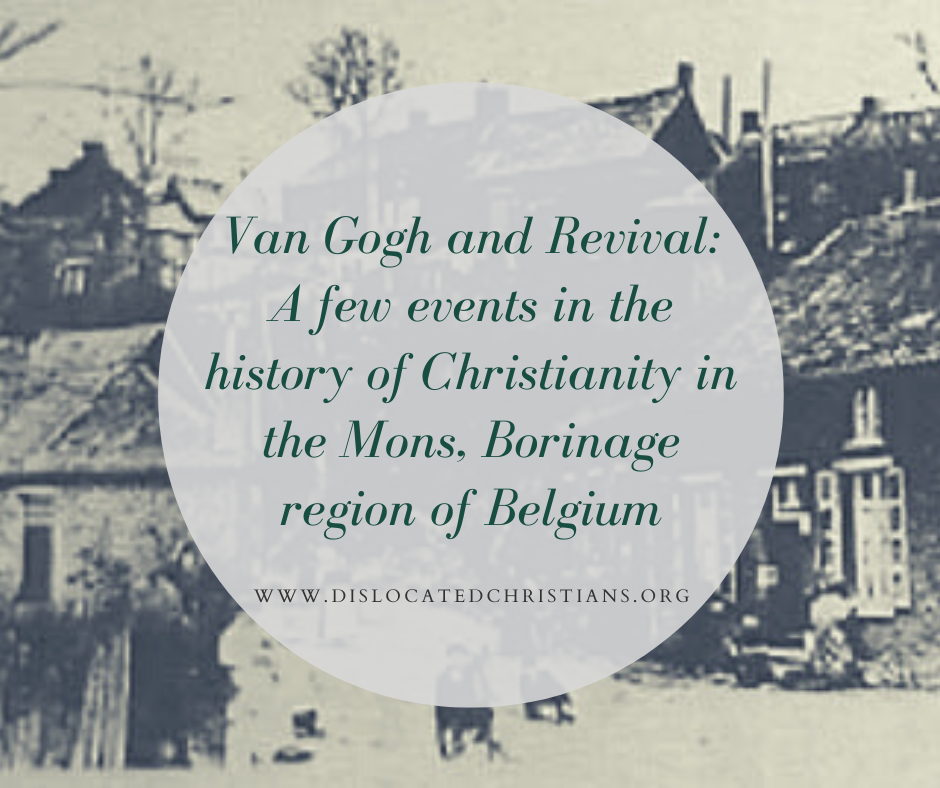
Our region also has a distinguished Christian history; from 1878 to 1880, Vincent Van Gogh was an evangelist among the mining villages in the Borinage (from the French for bore or mineshaft), an area south of Mons that extends to the French border. During the years that Vincent Van Gogh lived here, he selflessly gave all he could to help the impoverished miners and their families. He felt deep compassion towards those he was ministering to, and at times, he forsook all he had to bless them. His own basic needs were put aside, and he became extremely unwell; I find his story both inspiring and sad.
Between the wars, there was a revival in the Borinage thanks to missionaries who had been impacted by the Welsh Revival that occurred at the start of that century. As members of my church and I meet each week to ask God to touch the people in this area, it is encouraging to recall that the Holy Spirit has moved here before. I hope you, too, will be heartened by these stories of God at work.
Vincent Van Gogh – Giving up everything for God
Vincent Van Gogh grew up in the Netherlands as a member of the Dutch Reformed Church. Yet, while working in the art trade in London, he felt simultaneously disillusioned by the art world’s fixation on profit and drawn to the church. He immersed himself in the Bible and began to believe that he had to die to himself to serve God. He felt a deep calling to preach and began seeking opportunities to serve, leading to him becoming a part-time preacher in London. He especially enjoyed preaching to the residents of the poorest slums, such as those in Whitechapel, where he felt he was walking in Charles Dicken’s footsteps. I love his description of those he preached to: he believed they had been robbed of the ‘early dew of morning’ because of their hard lives. Time and again, Vincent Van Gogh utilises similarly evocative imagery in his preaching and to describe his calling. In his sermons, he drew on deeply descriptive passages, such as the deer panting for water, storms and the parables. He also speaks of light, which is to become one of the key motifs in his later paintings.
Vincent Van Gogh comes across as heartfelt, humble and contrite throughout his letters and sermons. His messages were simple, full of resolute faith and came directly from his heart. Just like his paintings, which were not appreciated in his lifetime, his preaching was also not greatly admired. Still, he clearly experienced enormous compassion for the lost souls of London, especially immigrants. He felt he was a foreigner among foreigners. There were also some hints of his later mental illness when he described himself as sorrowful yet always rejoicing. He was sorrowful because life was tough and lonely in London but hopeful because he felt he was on the right path by pursuing his calling as a preacher.
As a result of his experiences, he quit his job in the art trade and returned to the Netherlands, his native country. Once there, he travelled to Amsterdam for theological training to become a ‘real’ preacher like his father. Sadly, however, he failed the state exams, which required knowledge of Latin, Greek, Maths and other subjects that were overly academic for him. His tutors had observed that he was consumed by the desire to care for the unfortunate, and they watched him dealing gently with the deaf, mute and those with deformities. However, he could not continue his studies despite his actions and passion for the church and the lost.
Around this time, several events betray his state of mind. First off, he was pleased that someone recognised him as a Christian. Perhaps he felt so out of step with the course and his fellow students that he needed this confirmation. He continued to want to die to himself to please God and would chastise himself when he failed his courses. He mentions using a stick on himself, though this is unconfirmed, and would deny himself a coat when it was cold. These actions bordered on self-harm. At this time, he also wrote, ‘Everything is more miraculous than one can understand’, which I find both touching and inspiring.
Thankfully, his situation after leaving Amsterdam improved when, at his father’s suggestion, he discovered a course in Brussels, Belgium, that was less academically rigorous and where he could train as an evangelist. He was excited and relieved to discover such a course existed and travelled to Brussels with high hopes. The course’s definition of an evangelist as midway between preacher and missionary seemed to describe exactly how he wanted to serve, and the programme was only three years in length, half that of the Amsterdam course. There was also a focus on practical ministry; from the outset, his vision was to take the gospel to mineworkers in the Borinage.
Unfortunately, the course in Brussels required the payment of fees, and since he was Dutch rather than Belgian, he was not entitled to the same bursaries that the other Belgian students were. He, therefore, had to drop out again after completing just three months of study. His father gave him more helpful advice and suggested he go to the Borinage and serve there as a missionary anyway. After spending time there, Vincent hoped to return to Brussels to complete the training with some experience and something to say for himself.
To Vincent’s joy, after just a month in the Borinage, he was appointed as an evangelist by a Belgian missionary society and, from then on, received a small stipend. He began to preach in the existing protestant communities and led bible studies in homes. Vincent arranged to go down one of the mineshafts and vividly described how it felt. As he learned more about the miners’ lives, he felt their pain.
Van Gogh’s desire was for his position as an evangelist to become permanent, and he began to deeply embed himself in the lives of his flock. He was commended for his meekness and simplicity and continued to push himself to learn to be humble. When visiting the sick, he invariably gave away his food and stipend to help those he saw in need. Using his bed linen, he bound up wounds the miners had received while working below ground. Vincent moved out of his comfy room to demonstrate his solidarity with the miners and, over a relatively short period, gave away all he owned, including all his savings, which he used to buy bibles, he also passed on his clothes and his bed. He slept on a plank instead.
By this time, Van Gogh had also given up ‘Dutch’ cleanliness and soap and considered abstaining from them a form of piety. He had no concern for his own welfare and spent many hours tending to the sick and caring for animals. His hard work was rewarded, and some conversions accompanied his ministry. One, in particular, stands out; Vincent went to visit a renowned alcoholic who had been injured in the mine, and although he was met with profanity, after demonstrating ‘evangelical tenderness’ (what beautiful words!), the man came to faith and was a changed character.
Though he was physically suffering during this period, Vincent does appear to have found satisfaction and pleasure in his role. He was happy with his lot, but the missionary society thought differently; Vincent was far too radical for them and was removed from his post. His zeal for the lost had become scandalous. Vincent’s father came to collect him from the Borinage and found his son emaciated and sick. In their official verdict on Vincent Van Gogh’s conduct, the missionary committee stated that Vincent did not have the ‘gift of the word’, so they had to let him go; his compassion and solidarity with the poor were disregarded entirely.
Vincent went on to have a troubled art career, and some say he gave up his faith on leaving the Borinage, but I find this hard to believe. In my view, it is more accurate to say that he gave up on the church when he left the Borinage, but his Christian faith and spirituality remained. Our generation’s buzzword to describe this is to say he became de-churched. There is much more to learn about Van Gogh’s faith in A. Wessels’ thorough book about him; I highly recommend it.
God had not forgotten the Borinage after Vincent Van Gogh’s departure, and 50 years later, the Holy Spirit was at work again.
Revival in the Borinage
I’m grateful to Jan van Binsbergen, a leader at my local church here in Mons, who gave me one of the essays he wrote during the 1980s at Bible College in Brussels. In it, he describes the history of his church, Centre Vie Nouvelle (New Life Centre), in Jemappes. During his research, he spoke with Gilberte Carlier, known to everyone as Bobonne Gilberte (‘Missus’ Gilbert). In 1988, this elderly lady was 72 years old and had attended the church since 1933, when she experienced the revival firsthand.
As we know from Vincent Van Gogh’s story above, some Protestant churches were already in the Borinage. The revival began at one of these in the small district of Paturages, where H DeWorm was the pastor. In 1931, Pastor DeWorm invited the English evangelist Douglas Scott to conduct meetings at the church each day during one week in September. (Later on, Douglas Scott helped to establish the Assemblies of God in France). Douglas Scott returned a year later, in 1932, for another week of meetings, and this time, he was accompanied by Donald Gee. Donald was a Londoner and had been converted to Christianity when Seth Joshua came to Finsbury Park and preached to a vast crowd. Seth, for his part, had mentored Evan Roberts, who led the Welsh Revival in 1904-5. Though Douglas Scott didn’t reach the Borinage until a quarter of a century after the Welsh Revival, the ripple effects of that significant move of God still had an effect.
Initially, Douglas Scott was to preach at the protestant church in Jemappes, but the pastor there formed a negative opinion of Scott, so Scott was forced to move on. At this point, Pastor DeWorm invited him to carry out his work from Paturages. When Donald Gee accompanied Scott a year later, their ministry was predominantly evangelistic and wonderfully, there were many conversions. Cafés and bars in the area emptied as people came to faith, and a profusion of new churches was begun.
Sadly, some of the divisions that had formed the year before remained, resulting in a lack of unity among the churches in the Borinage. Some of these issues carried on until the 1980s when Jan carried out his research; the region is riddled with many small churches as a result. Of course, the fighting in this area during World War II also gave the people reason to mistrust each other.
Douglas and Gee returned each year to the Borinage to conduct a series of meetings. On one of them, they met Jean Neusy, a native pastor who had been proselytising in the area for over two years and had met with ‘total incredulity’ from the locals. However, Neusy had been holding well-attended revival prayer meetings, and Bobonne Gilberte remembered attending these. She and her husband would push their youngest daughter in a pram the 8 kilometres to the prayer meetings, which were scheduled in the morning and evening. They didn’t go home between the meetings but stayed to pray. She said,’ We didn’t waste our time; we were all seeking God on our knees in the room above the sanctuary. It would usually be there that the people received the Holy Spirit baptism’. Steadily, the number of believers and churches increased, and this move of God can be called a revival.
Pastor DeWorm confirmed this and wrote in 1958 that ‘our church was a blood donor to the rest of the Borinage. From 1934 and on, many enthusiastic families left us to start their own communities. Jean Neusy was one of those who went to pioneer a new ministry, and Pastor DeWorm had no bitterness about this. They were glad to have been part of the Spirit’s work.
Unfortunately, I do not have access to many further details about the revival in the Borinage. However, Bobonne Gilberte was a faithful Christian for over half a century until her death, and her children continue to serve churches in the area; there is a lasting legacy. Many small Christian communities continue to meet across the Borinage. Over time, their numbers have dwindled, and a fresh move of the Spirit is needed. Please can I ask you to pray for southern Belgium?
Sources
‘A kind of Bible’ Vincent Van Gogh as Evangelist by A. Wessels, 2000
Feathers of Hope by Sharon Garlough-Brown, 2022
Revival by Brian H. Edwards, 2019
Saturated by God by Malcolm MacDonald, 2023
DislocatedChristians exists to create and support a community of like-minded people. I’ve described myself as Dislocated because I sometimes struggle to understand how God wants me to be in the world, but not of the world. I also move house a lot!
Please like, comment on, or share my articles if you’ve found them helpful. I’d be immensely grateful if you could follow me; just click towards the bottom of the page.
If you’d like to support my writing, please consider buying one of my books. I’m undertaking some challenging (and costly) new projects, and if you’d like to encourage me with them, please consider buying me a coffee on Kofi.
Just as we are each a work in progress, so too is DislocatedChristians. Sometimes I’ll get things wrong, and I hope you’ll forgive me and continue to stick around when that happens.
Discover more from Dislocated Christians
Subscribe to get the latest posts sent to your email.
 Dislocated Christians
2 Comments